Showing posts with label evolution. Show all posts

Tuesday, October 31, 2017

Grandma, what a big brain you have!

All the better to survive with, my dear


Used with permission from Nicola L. Robinson.

Editor’s Note: SciColl held our first community workshop on Emerging Infectious Diseases in October 2014. This October we're posting several pieces that highlight the important work where collections continue to play an integral role.

Editor’s Note: SciColl intern, Ebubechi Okpalugo from Pembroke College, contributed this article as part of her time in the SciColl office during Summer 2017.

Sit down with a prehistoric relative of ours from the genus Homo - their extinction making it a lot easier said than done - and you’ll notice something significantly different: their heads, and therefore brains, are a fraction of the size of a modern human’s. Why exactly did brain size increase? Quite simply, large and complex brains can process and store more information, which was hugely beneficial to humans as they developed skills and social interaction.

The Smithsonian NMNH Human Origins exhibit houses a collection of fossil skull remnants dating back as far as 3 million years ago, as well as silicon reconstructions of early humans. One can see a gradual change in facial features, body hair and most significantly, head shape and size. Over the course of human evolution, it’s found that brain size tripled, with the modern human brain being the largest and most complex of any living primate. But, size alone doesn't tell us much about thinking ability.

Here’s a bit of what we know. 

Thursday, May 19, 2016

A Brief History Camels (And Humans)

Fig.1. Dromedaries in Israel (Credit: Wilson, 2011)

For the past 3,000 years, single-humped camels, known as dromedaries (Camelus dromedarius), have provided an important source of food and transport to desert communities. The origin of the domesticated dromedary, however, remains relatively unknown. A recent article published in the journal Proceedings of the National Academy of Sciences, reveals some clues as to where and when humans started to depend upon these animals.

Wednesday, May 11, 2016

Tale of Two Beaks: Darwin and the 21st Century

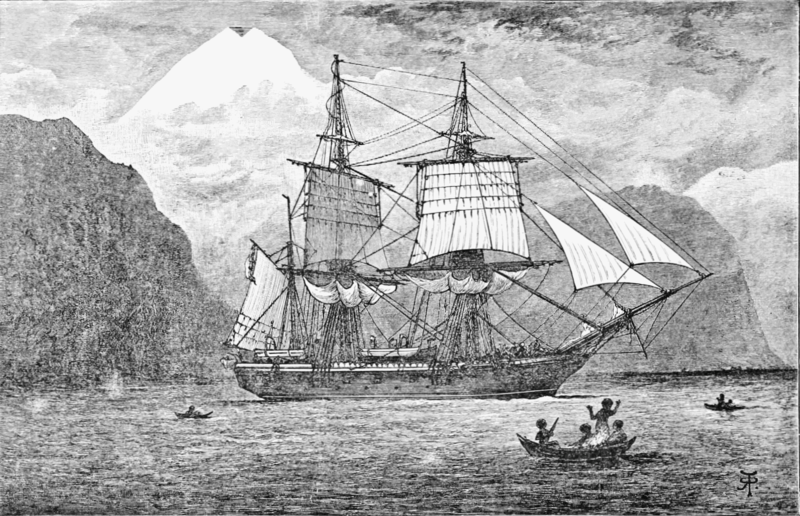
Fig.1. HMS Beagle in the Strait of Magellan (Credit: R.T. Pritchett, 1900

On 11 May 1820, the HMS Beagle was launched from the Woolwich Dockyard on the River Thames. Out of three voyages around the world to survey both land and sea, its second and easily most famous voyage cemented the ship’s role in history, thanks to the efforts of a young passenger named Charles Darwin. Now, nearly 200 years later, scientists have returned to the same birds that came to symbolize Darwin’s work in a study that captures evolution in action.

Thursday, March 31, 2016

The Assassin (Flies) of Entomology


Editor's Note: This is the second in a series of videos we will release in 2016 about the use of scientific collections and DNA technology.

Torsten Dikow has traveled around the world to find the perfect fit. And he seems to have found it at the Smithsonian’s National Museum of Natural History (NMNH).

Friday, February 5, 2016

In the News: Mammoth for Dinner?

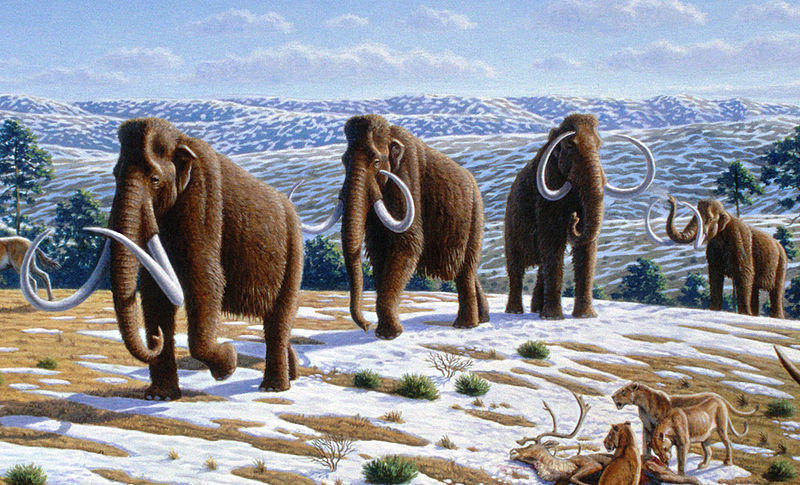
Fig.1. Woolly mammoths (Mammuthus primigenius) in late Pleistocene landscape
(
Credit: Mauricio Antón, 2004)

From ices cores to mammoth meat, this week is full of curiosities frozen in time. A return to these specimens reveals an important software error, a lesson in evolution, an answer to a decades-old question, and more:

Wednesday, January 13, 2016

The Iceman's Stomach Bug

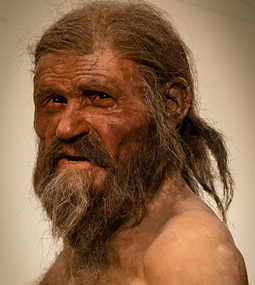
Fig.1. Reconstruction of Ötzi
(
Credit: Thilo Parg/Wikimedia Commons, License: CC BY-SA 3.0)

In 1991, two hikers stumbled upon a mummy high in the Ötztal Alps, right on the border between Austria and Italy. This mummy - nicknamed Ötzi, or the Iceman - is Europe’s oldest natural human mummy and is arguably one of the most studied cadavers in science. From his eye color (brown) to his dental health (poor), Ötzi reveals an amazing amount about how Europeans looked and lived 5,300 years ago. An international group of scientists released a study last week in the journal Science that added yet another detail to the treasure trove of research on the corpse, which may inform our understanding of ancient human migration into Europe.

Wednesday, December 16, 2015

The Dawn of Birds

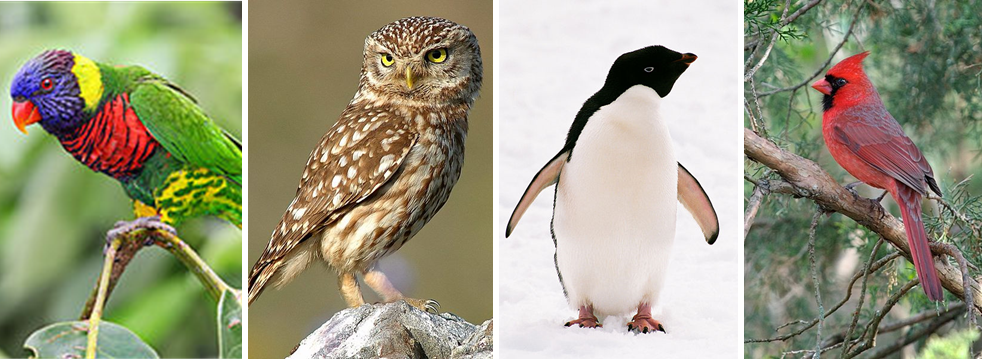
Fig.1. A green-naped lorikeet, a little owl, an Adélie penguin, and a northern cardinal show only a fraction of the remarkable diversity of birds (Credit: Benjamint, 2009Trebol-a, 2011Reinhard Jahn, 2007; & Stephen Wolfe, 2011)

Around 65 million years ago, one of the largest mass extinction events in Earth’s history occurred. An estimated 75 percent of all species went extinct, from non-avian dinosaurs to types of mollusks, plankton, insects, and plants. With extinction, however, came the chance for animals like birds to diversify and expand into empty ecological niches in a process called adaptive radiation. Although the Cretaceous-Paleogene extinction event (K-Pg) may have enabled the rapid evolution of new species of birds, research published last Friday in the journal Science Advances suggests that birds have a much longer and more complicated history than previously thought.

Friday, November 13, 2015

In the News: Around the World and Back in Time

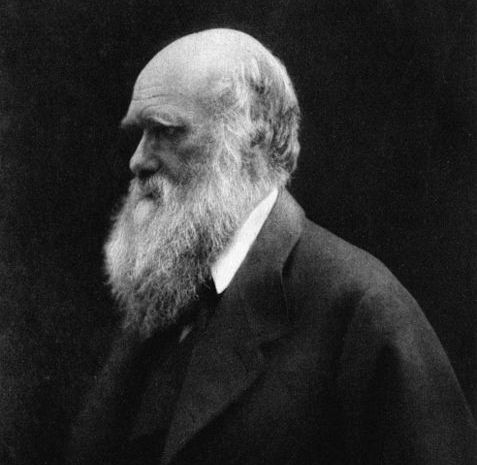
Fig.1. Charles Darwin in 1868 (Credit: Julia Margaret Cameron, 1868)

Instead of sailing to the other side of the world like Darwin, modern evolutionary biologists can scope collections for insight into ancient changes. Online digitized records, hands-on staining, and teeth hidden in collections are being used to rewrite the evolutionary history of animals:

Tuesday, November 10, 2015

Teosinte Today, Maize Tomorrow

Fig.1. This photo, published in 1919, shows the stages between a simple spike of Euchlaena mexicana and an ear of maize. (Credit: Journal of Agriculture)

Jeffrey Ross-Ibarra, associate professor and section chair of the Department of Plant Sciences at the University of California at Davis, and his team study maize and teosinte evolution. Researchers and post-docs - with backgrounds in plant biology and population biology and integrated genetics and genomics - focus on various research areas, such as genetics and genomics, how human and environmental factors have affected the adaptation and domestication of crops and more.

“Domestication (of the crop) has always struck me as a really exciting story because it’s a case where the evolution of the plant was directed by, or affected by, humans,” Ross-Ibarra said about how he became interested in maize and teosinte research.