Showing posts with label ocean acidification. Show all posts

Thursday, April 28, 2016

Fossils and our Future Climate

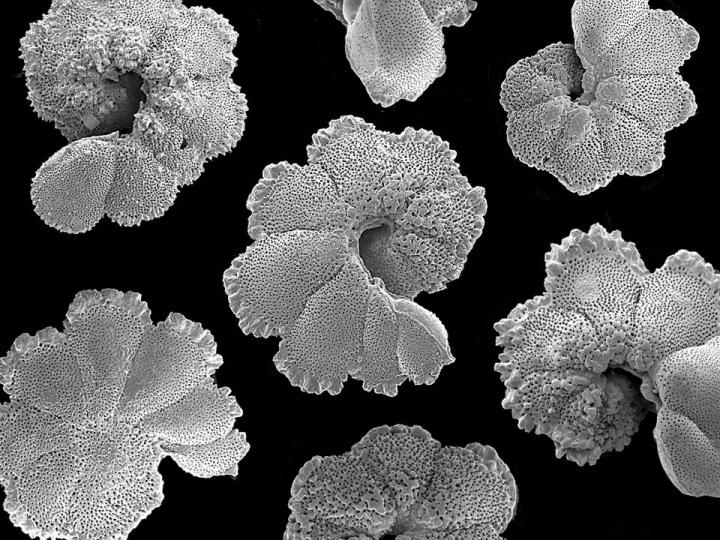
Fig.1. 40 million year old fossil planktonic foraminifera from Tanzania 
(Credit: Paul Pearson/Cardiff University)

According to a study published this week in the journal Nature, tiny fossils from 53 million to 36 million years ago may help to predict the future of climate change. This research, led by scientists from the University of Southampton and partners around the United Kingdom, sheds light on the relationship between atmospheric carbon dioxide (CO2) and climate during an ancient period in Earth’s history known as the Eocene Epoch.

Friday, December 11, 2015

In the News: Moby-Dick and the Future Seas


As the climate talks in Paris come to a close - and as we wrap up GIF week with Deep Sea News - we learn more about ancient and recent marine collections that might save our warming seas. This week, we read about a miniature "Moby-Dick" from ancient times, the future of the Mediterranean, citizen science efforts, and more:

Wednesday, December 9, 2015

Bones of Coral Reefs

Fig.1. Coral depends upon algae for survival (Credit:via GIPHY)

In the middle of the Pacific Ocean, just off the small island of Kiritimati, corals are dying off at an astonishing rate. The small atoll, also called Christmas Island, suffers from high water temperatures caused by the current El NiƱo that have reached 4℃ above normal. Although these temperatures might be nice for a beachgoer, they do not bode well for the survival of the atoll’s extensive coral reefs.

Friday, April 17, 2015

In the News: A Changing Tide


Fig.1. This humpback in Stellwagen Bank National Marine Sanctuary is part of a long line of an unusual group of animals recently studied at the University of Otago (Credit: Whit Welles, 2007)

This week in collections science, the ocean and its inhabitants take center stage. Learn about ancient ocean ecosystems, marine animal evolution, transmissible clam cancer, and more in #FollowFriday.

Tuesday, November 18, 2014

"Evil Twin" of Climate Change


Fig.1. A pteropod (sea butterfly) shell placed in seawater with pH and carbonate levels projected for year 2100. The shell dissolved over 45 days. (Credit: David Liittschwager/National Geographic Stock)

A routine survey off the U.S. West Coast conducted by the NOAA Ocean Acidification Program in 2011 found frightening results. More than half of their collected pteropods (sea butterflies) had severely dissolved shells. The ocean’s absorption of human-caused carbon dioxide emission created an acidic environment that has only recently caught the public eye. Now dubbed as “climate change’s evil twin,” ocean acidification represents a serious problem brought about by global warming. As more carbon dioxide dissolves into the ocean, marine organisms and the humans that depend upon them are put at risk.
