Showing posts with label dinosaurs. Show all posts

Tuesday, March 8, 2016

The Fossil Hunter of Lyme Regis

Fig.1. Portrait of Mary Anning with her dog, Tray
(
Credit: NHM London, Public Domain) 

In 1799, Mary Anning was born to Richard and Mary Anning of Lyme Regis, a quiet town on the southern tip of England. Despite a lack of formal schooling and financial struggles, Anning would become one of England's most prolific fossil collectors. Her finds - including the first two plesiosaur skeletons ever found, the first pterosaur skeleton found outside of Germany, and the first ichthyosaur to be recognized - wound up in private collections and museums around Europe, laying the foundation for the emerging fields of geology and paleontology.

Wednesday, December 16, 2015

The Dawn of Birds

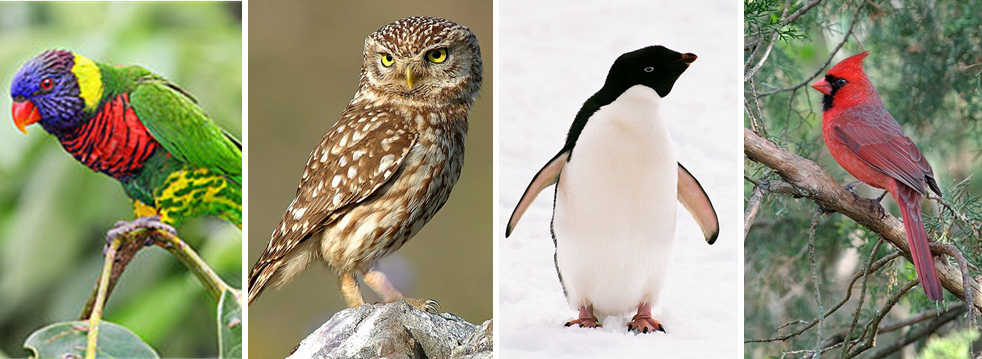
Fig.1. A green-naped lorikeet, a little owl, an Adélie penguin, and a northern cardinal show only a fraction of the remarkable diversity of birds (Credit: Benjamint, 2009; Trebol-a, 2011; Reinhard Jahn, 2007; & Stephen Wolfe, 2011)

Around 65 million years ago, one of the largest mass extinction events in Earth’s history occurred. An estimated 75 percent of all species went extinct, from non-avian dinosaurs to types of mollusks, plankton, insects, and plants. With extinction, however, came the chance for animals like birds to diversify and expand into empty ecological niches in a process called adaptive radiation. Although the Cretaceous-Paleogene extinction event (K-Pg) may have enabled the rapid evolution of new species of birds, research published last Friday in the journal Science Advances suggests that birds have a much longer and more complicated history than previously thought.

Friday, November 6, 2015

In the News: The Terror of the Midwest

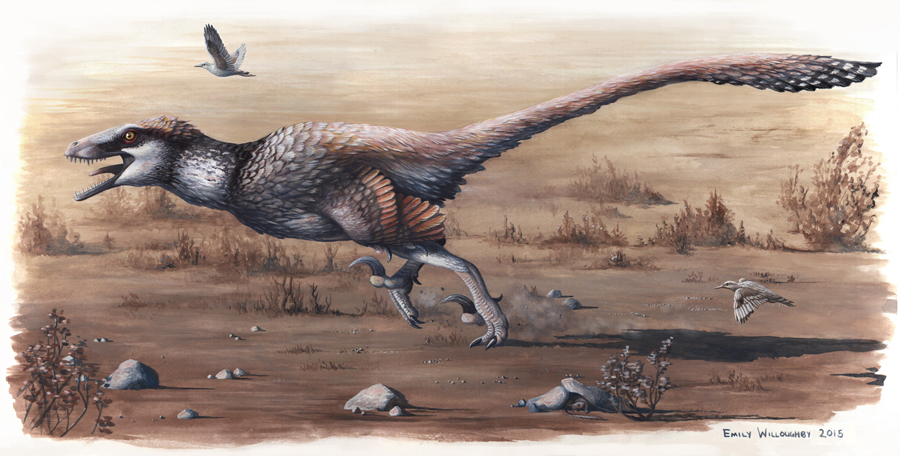
Fig.1. Artist illustration of Dakotaraptor steini, DePalma et al 2015
(
Credit: Emily Willoughby, 2015) 

The recently described Dakotaraptor, found in the Hell Creek Formation of South Dakota, is only one of several species in the news this week who give a glimpse into ancient history. Read to learn about a baby Pentaceratops, fire-frogs, sea urchins, and more!

Friday, October 16, 2015

In the News: A Celebration of Bones

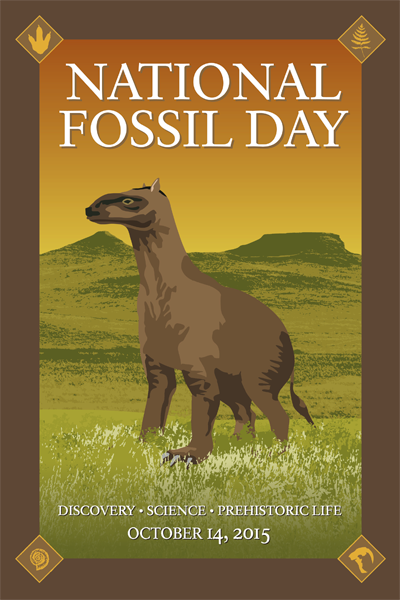
Fig.1 A chalicothere in a Miocene grassland
(
Credit: National Fossil Day™ 2015)

In honor of National Fossil Day this week, learn about exciting finds in paleontology and paleoanthropology. From human migration to climate change, these bones open a new window into ancient history:

Wednesday, July 8, 2015

Rulers of the Sea

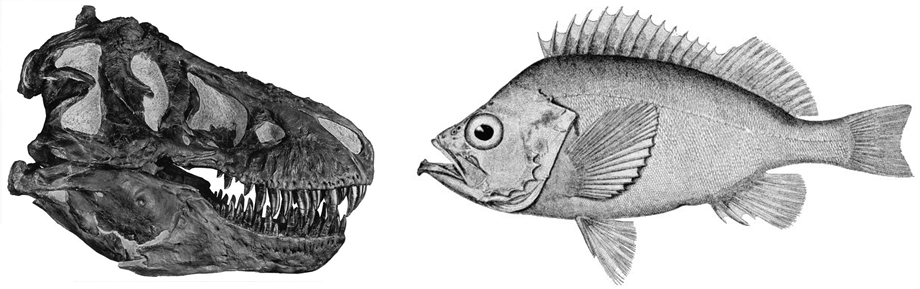
Fig.1. The T. rex died out 66 million years ago, along with other non-avian dinosaurs, leaving ray-finned fishes to dominate in the waters (Credit: A.E. Anderson, AMNH 5027 [left] and Magnus Manske, 2004 [right])

Even though we were excited to see a Tyrannosaurus rex in “Jurassic World,” it is probably best that they stayed in the Cretaceous. Humans and dinosaurs certainly do not mix, but ancient mammals lived side-by-side with the T. rex. That is, until the asteroid killed off all non-avian dinosaurs in the Cretaceous-Paleogene [K/Pg] extinction event, leaving an ecological void for mammals to evolve and ultimately dominate in terrestrial ecosystems. A recent study published in PNAS by paleobiologists at UC San Diego suggests a similar story unfolded with the evolution of fish in the oceans.

Friday, June 12, 2015

In the News: Collecting for the Future


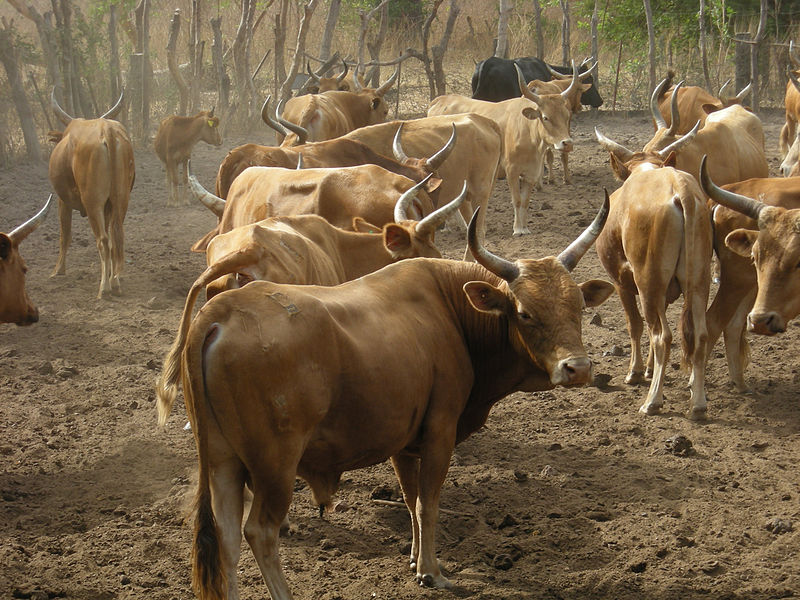
Fig.1. This N’Dama cattle herd in West Africa may hold the answer to livestock diseases which are sweeping across Africa and threatening food security (Credit: ILRI via Wikimedia, 2008)

Museums, herbaria, and genebanks all work to preserve the past so we can prepare for the future. Read about collections-holding institutions that must be protected in order to understand biodiversity, preempt epidemics, study dinosaurs, and more:

Friday, May 1, 2015

In the News: Jurassic Park Herbivores and More


Fig.1. The bones of this curious, plant-eating dinosaur was found by a seven-year-old in Chile (Credit: Gabriel Lio)

This week in #FollowFriday, exciting research projects show how vital museums are to the scientific community. Read about a new oddball dinosaur, a biodiversity center in peril, the cycle of climate change, and more:

Friday, April 10, 2015

In the News: Return of the Thunder Lizard


Fig.1. The Brontosaurus can finally reclaim its place as a real species (Credit:Davide Bonadonna/Creative Commons)

This week in science brought us a new dinosaur, “extreme” museum exhibits, and a seed bank which might one day save the world. Read this #FollowFriday to learn more about the weird and unknown side of collections: