Showing posts with label plague. Show all posts

Thursday, June 23, 2016

The Origin(s) of Outbreaks

Fig.1. Color print of Aedes aegypti mosquito
 (
Credit: Emil August Goeldi, 1905
) 

On Monday, the Democratic Republic of the Congo (DRC) declared a yellow fever epidemic in three provinces, including the heavily populated capital of Kinshasa. The current outbreak has killed more than 300 people in Angola and depleted the world’s vaccine stockpile to protect people in Angola, DRC, and Uganda. Although the outbreak is largely confined to central Africa, scientists worry about its potential spread to Asia, where 2 billion people live in areas infested with the disease’s vector, the Aedes aegypti mosquito.

Public health officials do not yet know which factors led to this event becoming the deadliest yellow fever outbreak since 1971. Whether the virus became more virulent or it came in contact with new populations, the question of why now sits at the heart of every outbreak. To answer this question, scientists are teasing apart the genetic and environmental factors that make a disease tick. 

Wednesday, October 28, 2015

Striking Gold (Teeth) with Ancient Plague DNA

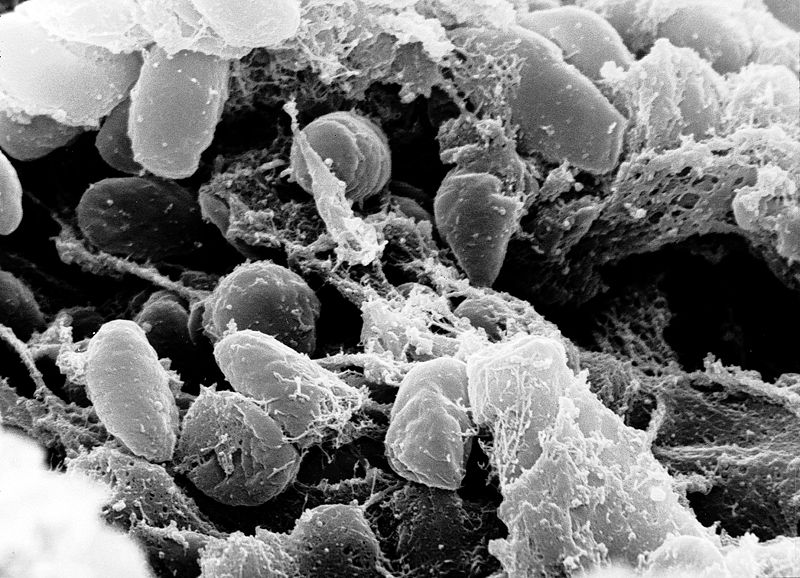
Fig.1. Scanning electron micrograph of Yersinia pestis bacteria mass in foregut of a flea
(Credit: Rocky Mountain Laboratories, NIAID, 2010)

Since the beginning of the year, fifteen people in the United States have been infected with the bubonic plague, and four of those individuals have died. This disease, often only mentioned in context of the Black Death (1346-1353 AD) or the Justinian Plague (541-542 AD), still exists today in pockets around the world. The causative pathogen Yersinia pestis hides in natural reservoirs, such as black-tailed prairie dogs in the southwestern United States or marmots in the Eurasian Steppe, only to flare up in human populations when rodents and the fleas they carry get too close.

Despite the deadly history of the disease - the Black Death killed an estimated 60 percent of the European population - Y. pestis evolved from a much less virulent ancestor that caused symptoms closer to the common cold. Previous research pinpointed the first appearance of this bacterium in skeletal remains at 1,500 years ago, but a study released last week in the journal Cell pushes that date back to more than 5,000 years ago.

Wednesday, March 4, 2015

Gerbils, Tree Rings, and Plague, oh my!


Fig.1. This adorable great gerbil (Rhombomys opimus) found in Central Asia could be to blame for the spread of plague into Europe during the 1300s (Credit: Yuriy75, 2009).

When traveling to New York City, you might want to avoid touching surfaces within the subway. According to a recent study, nearly 15,000 different microorganism species were found along railings, ticket kiosks, seats, doors, and poles. Of that number, about half the organisms were bacteria, including the causative agent for the bubonic plague, Yersinia pestis. Although the infamous New York City rats can carry this deadly disease, they might not be the rodents to blame for spreading the Black Death in the 14th century. A climatological study published in the Proceedings of the National Academy of Sciences might overturn this long held belief about how the pandemic killed millions in Europe, Asia, and Africa.

Wednesday, October 29, 2014

Experts talk scientific collections' role in disease research

Some of the world’s leading minds in emerging infectious diseases met Thursday and Friday at the Smithsonian’s National Museum of Natural History to discuss scientific collections’ role in the disease outbreak cycle and research.

Wednesday, September 17, 2014

Tracing the History of Disease

In 1894, two research physicians independently identified the bacterium that causes bubonic plague. The bacillus, now known as Yersinia pestis, had finally been found as the pathogen to a disease that killed millions. This discovery was timely because just six years later the plague arrived to the United States on a ship carrying passengers from Hong Kong to San Francisco. Over the next nine years, the bubonic plague swept through the city.

Wednesday, September 10, 2014

A Modern Solution to an Ancient Problem

Eight centuries before the Black Death, a plague swept through the Byzantine Empire and then Europe with devastating consequences. More than 100 million people were killed from the 6th to 8th centuries in a pandemic known as the Plague of Justinian, or the first pandemic. Until last year, the cause of the disease was disputed, with arguments ranging from influenza to smallpox. Dave Wagner, an associate professor at Northern Arizona University, worked with scientists from around the world to confidently identify the bacterium Yersinia pestis as the cause of the pandemic.