 |
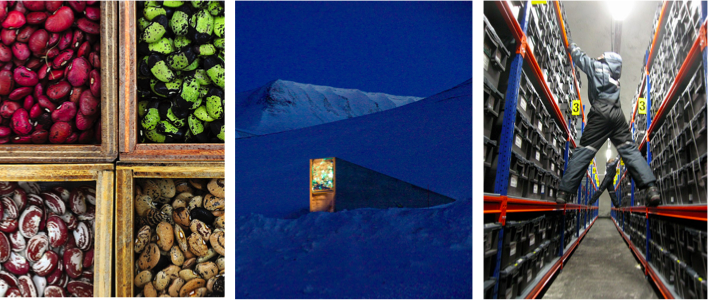
| Fig.1. Scenes from the Svalbard Global Seed Vault (Credit left to right: Neil Palmer/CIAT, 2011; Mari Tefre/Global Crop Diversity Trust, 2008; Dag Terje Filip Endresen/Svalbard Global Seed Vault, 2008) |
Earlier this year, the International Center for Agricultural Research in the Dry Areas (ICARDA) made a request to withdraw seeds from the Svalbard Global Seed Vault, which holds more than 850,000 samples from every country in the world. This request is the first of its kind for the “Doomsday Vault” that holds duplicate seed samples for national and international gene banks. The Syrian civil war forced ICARDA to move its headquarters from Aleppo, Syria, to Beirut, Lebanon, in 2012, and researchers managed to save 80 percent of the seed samples by sending them into storage at Svalbard.
Although such a withdrawal will allow ICARDA to regenerate these precious samples, it reveals the vulnerability of collections to war or even natural disasters. The year of 2015 marked a specific effort by individuals and organizations around the world to protect and sustain scientific collections, from those housed in natural history museums to frozen specimens in gene banks. We identified major trends that have affected both how collections are viewed in science and policy, as well as how they can be protected for generations to come. Read to learn more about what happened in the collections world this year, and what you should watch out for in 2016.