(Credit: Lynn Johnson/National Geographic Creative)
Monday, April 4, 2016
Monday Morning Coffee Break: April 4
Labels:
ancient DNA
,
cannabis
,
collection
,
DNA
,
genome
,
genomics
Thursday, March 31, 2016
The Assassin (Flies) of Entomology
Editor's Note: This is the second in a series of videos we will release in 2016 about the use of scientific collections and DNA technology.
Torsten Dikow has traveled around the world to find the perfect fit. And he seems to have found it at the Smithsonian’s National Museum of Natural History (NMNH).
Labels:
biorepository
,
collection
,
DNA
,
DNA sequencing
,
entomology
,
evolution
,
genome
,
NMNH
,
scientific collections
,
Smithsonian
,
Torsten Dikow
,
video
Monday, March 28, 2016
Monday Morning Coffee Break: March 28
Labels:
climate change
,
collection
,
environmental change
,
natural history
,
new species
Friday, March 25, 2016
Wild Plants and the Future of Crops
| Fig.1. Members of CIAT’s Genetic Resources Program in the minus 20℃ gene bank (Credit: Neil Palmer/CIAT, 2010) |
According to a recent study in the journal Nature Plants, around 95 percent of wild relatives of agricultural crops are insufficiently safeguarded in gene banks around the world. These crop wild relatives (CWR) are closely related to domesticated plants and have become increasingly important in efforts to protect crops against threats like drought, pests, and disease.
Labels:
agriculture
,
crop wild relatives
,
Food Security
,
genebank
,
scicollfood
,
seed banks
Monday, March 21, 2016
Monday Morning Coffee Break: March 21
Labels:
climate change
,
CO2
,
environmental change
,
ice cores
Wednesday, March 16, 2016
Slavery and the Spread of Disease
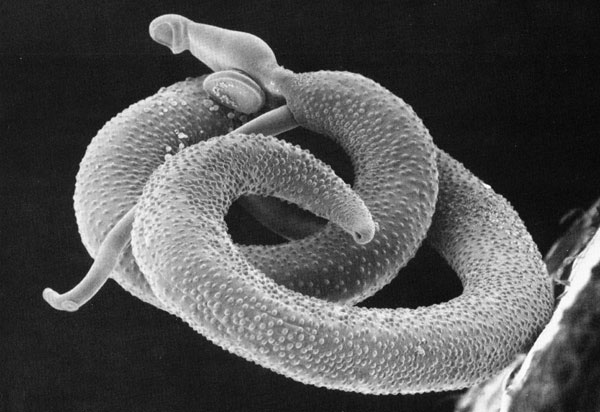
| Fig.1. Scanning electron micrograph of a pair of Schistosoma mansoni. (Credit: Davies Laboratory Uniformed Services University, Bethesda, MD) |
The transatlantic slave trade, which brought millions of Africans to the New World, connected four continents in a massive operation that lasted from the 16th to the 19th centuries. A recent study published in the journal Science Reports revealed that slave traders during these centuries contributed not only to an ongoing and tragic business in human lives, but also helped spread a parasitic disease around the world.
The parasitic fluke Schistosoma mansoni is one of several species that causes schistosomiasis (bilharzia), a Neglected Tropical Disease (NTD) found in almost 240 million people worldwide. This debilitating disease originated in East Africa and currently contributes to 20,000 to 200,000 deaths per year.
Labels:
emerging diseases
,
historical records
,
NHM
,
NTDs
,
parasites
,
SCAN
,
slavery
Monday, March 14, 2016
Monday Morning Coffee Break: March 14
Labels:
art
,
climate change
,
Monday
,
Monday morning coffee break
,
ocean acidification
Subscribe to:
Posts
(
Atom
)